
This is the 8th article in our “Designing Smart Learners” series, where we explore how attention, perception, and memory can be used to design brain‑aligned learning experiences in universities.
When a student struggles to grasp a complex concept, the default response is often to blame a lack of effort. However, cognitive science suggests a different perspective: learning difficulties often arise when teaching methods clash with the way the human brain naturally processes information.
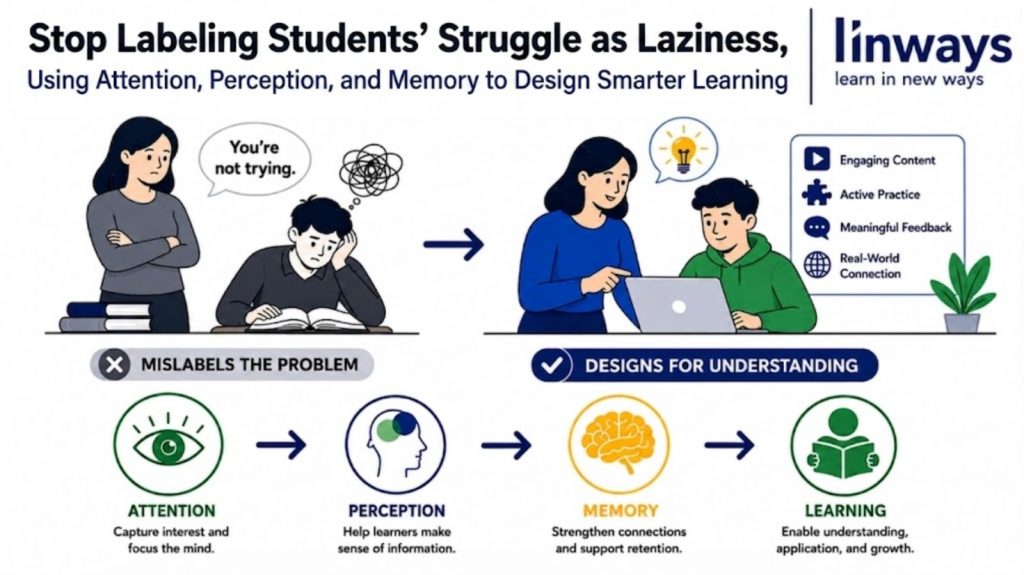
Learning is not just the passive acquisition of data. According to E. Bruce Goldstein, it is the outcome of an integrated cognitive system driven by three core pillars: Attention, Perception, and Memory. By understanding how these processes interact, universities can move away from traditional, passive instruction and instead design learner-centered environments that naturally foster critical thinking and long-term retention.
The Three Pillars of Cognitive Learning
Attention: The Foundation of Focused Learning
Attention enables learners to focus on relevant information while filtering distractions. In the modern world, students are constantly exposed to competing stimuli, making attentional skills essential for effective learning.
- Selective attention helps students concentrate on important information such as lectures, instructions, or discussions.
- Divided attention, or multitasking, may reduce concentration and increase cognitive overload when overused.
Actionable Strategies: Educators can sustain attention by moving away from uninterrupted, monolithic lectures. Breaking sessions into shorter segments, integrating interactive tools, and introducing active-learning breaks, such as brief peer discussions or quick quizzes every 15 to 20 minutes, keeps minds sharp and engaged.
Perception: Building Meaningful Understanding
Perception is the process of interpreting and organizing sensory information to create meaning. Students learn more effectively when they can connect new information with prior knowledge and real-life experiences.
Effective perceptual processing:
- improves conceptual understanding,
- strengthens critical thinking,
- and supports the practical application of knowledge.
Actionable Strategies: To sharpen student perception, abstract ideas should be anchored with concrete visuals. Utilizing simulations, real-world case studies, physical models, and multimedia demonstrations helps students visualize and organize complex information efficiently.
Refer to the blog: https://blog.linways.com/how-the-brain-turns-learning-into-knowledge-and-skill/
Memory: Supporting Retention and Application
Memory enables learners to encode, store, and retrieve information for future use.
- Sensory memory briefly registers incoming information.
- Working memory processes and organizes information during tasks such as reading, note-taking, and problem-solving.
- Long-term memory stores knowledge for later retrieval and application.
Strong memory processes help students retain concepts, connect learning experiences, and apply knowledge confidently in academic and practical situations.
Educators can support memory by:
- Using retrieval practice and recap quizzes,
- Encouraging spaced revision,
- Connecting theory with practical experiences,
- And promoting application-based learning activities.
Example: Short review activities and problem-solving tasks after lessons improve retention and understanding.
The Cognitive Learning Flow
In his research on cognitive psychology, E. Bruce Goldstein emphasizes that these three processes do not work in isolation; they function as a continuous, interdependent loop:
Attention → Perception → Memory → Learning
These cognitive processes work together continuously during learning:
- Attention selects relevant information,
- Perception interprets and gives meaning to it,
- Memory stores and retrieves the information for future use.
Weak attention can affect perception, while unclear perception can reduce memory retention. Prior experiences stored in memory also influence future attention and understanding, creating a continuous learning cycle.
For educators, understanding this cognitive flow is essential for designing effective and meaningful learning experiences.
Architecting Smart Learning Environments in Universities
To transition from traditional teaching to an outcome-driven, cognitive-aligned framework, universities can focus on a few systemic shifts:
- Faculty Development: Train educators in learner-centered instructional design rooted in cognitive science.
- Experiential Curricula: Prioritize multidisciplinary projects, lab simulations, and interactive problem-solving over passive listening.
- Strategic EdTech Integration: Utilize educational technology not just as a digital notepad, but as a tool to deliver adaptive, multimodal, and highly engaging content.
- Authentic Assessments: Design evaluations that test active application and conceptual understanding rather than mere recall.
By aligning curriculum design and classroom delivery with the natural processing tendencies of the brain, higher education institutions can eliminate the friction that causes students to disengage. Designing for attention, perception, and memory allows universities to build a resilient, smart learning ecosystem—cultivating graduates who are confident, analytical, and fully prepared for lifelong success.
So far, we have looked at
- Designing Smart Learners: Helping Students Learn How to Learn.
- From Smart Learners to Smart Systems: How Universities Can Actually Support “Learning How to Learn”
- Metacognition in Action: Building Learners Who Can Guide Their Own Learning
- How the Brain Turns Learning into Knowledge and Skill.
- Knowledge to Skill to Habit: Designing for the Full Learning Loop.
- The Architecture of Learning: Leveraging Learning Theories for Student Success.
- From Theory to Talent: Architecting Student Success Through Kolb’s Framework.
Book a personalized walkthrough with our higher education specialists.