

In our “Designing Smart Learners” series, we have been exploring what it takes to develop students who can truly learn how to learn. So far, we have looked at
- Designing Smart Learners: Helping Students Learn How to Learn.
- From Smart Learners to Smart Systems: How Universities Can Actually Support “Learning How to Learn”
- Metacognition in Action: Building Learners Who Can Guide Their Own Learning
- How the Brain Turns Learning into Knowledge and Skill.
In this article, Knowledge to Skill to Habit: Designing for the Full Learning Loop, we go one step further. We explore how acquired knowledge becomes skill, how repeated practice turns skill into habit, and how educators and systems can intentionally design for this full learning loop.
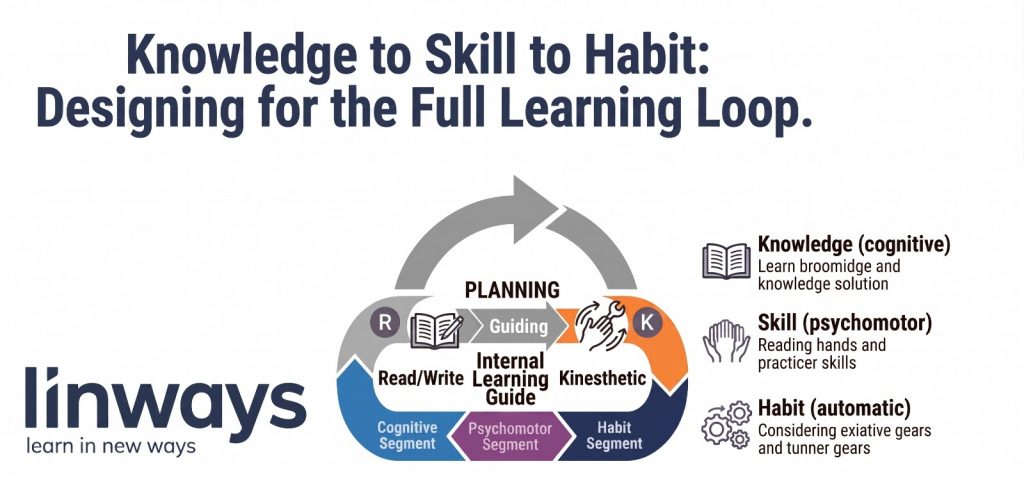
Most academic work starts in the cognitive space: understanding concepts, theories, and facts. But meaningful learning often needs to move beyond that into skill:
- Applying a theory to a real problem.
- Performing a lab procedure accurately.
- Presenting ideas clearly to an audience.
- Writing, designing, coding, or building something that works.
This movement from “I know this” to “I can do this” is a neuroplastic process. Neural circuits that were first engaged in abstract thinking now link to motor sequences, sensory feedback, and real‑time decision‑making.
If we look at it as a chain:
- Knowledge (cognitive) → Skill (psychomotor) → Habit (automatic, reliable performance)
Together, metacognition and neuroplasticity strengthen this chain. When institutions design learning experiences that:
- Make outcomes and expectations clear.
- Encourage students to plan their approach.
- Provide repeated, varied, and meaningful practice.
- Build in reflection before and after tasks.
…they are not just “covering syllabus”. They are helping students turn content into capability in a way that is literally encoded in the brain.
What This Means for Learning Systems and Platforms
If we accept that:
- Neuroplasticity is how all learning happens, and
- Metacognition can guide and strengthen this plasticity,
Then learning systems-curriculum, courses, platforms-should be organised around conditions that promote both.
This means designing for:
- Clear, visible outcomes so learners know what they are trying to build in their brains and in their skills.
- Pathways and activities that allow multimodal engagement-visual, auditory, reading/writing, and kinesthetic.
- Regular, low‑stakes opportunities for planning, checking understanding, and reflecting.
- Feedback that is timely, specific, and linked to strategies, not just marks.
- Tools that help students see patterns in their own behaviour and results, so they can choose better methods next time.
Teaching students about neuroplasticity itself, linking it to growth mindset and development, also gives them a powerful message: their learning potential is dynamic. It depends significantly on their attitudes, strategies, and practices, not just on “fixed intelligence”.
When learners see the brain as adaptable, and learning as a process they can guide, they are more likely to engage deeply, persist through difficulty, and experiment with smarter ways of studying.
Conclusion: Designing Learners Who Can Rewire Their Own Brains
Learning is not just the transfer of information; it is a change in the brain and in behaviour. Neuroplasticity explains how that change happens at a biological level. Metacognition explains how learners can participate in and guide that change.
Bringing these together, we can:
- Help students understand why practice, reflection, and strategy matter.
- Support them in choosing learning methods that fit their type and context.
- Build systems and platforms that make metacognitive habits and neuroplastic conditions part of everyday academic life.
In short, we move from “delivering content” to “designing experiences that help learners rewire their own brains”.
In the next part of this series, we will explore learning theories, practical metacognitive activities and templates, checklists, reflection prompts, and simple workflows that institutions can plug directly into their courses and platforms. We will also see how a good academic management platform can nudge these behaviours, and quietly support the neuroplastic changes that turn learning into lasting knowledge and skill.
Next Blog: The Architecture of Learning: Leveraging Learning Theories for Student Success.
Book a personalized walkthrough with our higher education specialists.