
In the previous article, Designing Smart Learners: Helping Students Learn How to Learn, we saw that learning is not a fixed talent but a skill that can be developed. With clear goals, metacognitive checks, and regular reflection, any student can become a more intentional and effective learner.
But there is a hard truth: individual effort is not enough.
If the system around the learner rewards only marks, deadlines, and compliance, then even the best learning habits will struggle to survive. To truly build smart learners at scale, we need smart systems that quietly support and nudge these behaviors every day.
This second article in the series focuses on the system side: how institutions can design programs, processes, and platforms that help students practice “learning how to learn” in their real academic journey.
1. Connecting Outcomes to “How” Students Learn
Most institutions today define:
- Program Outcomes (POs): What a graduate should be able to do after completing the program.
- Course Outcomes (COs): What a student should be able to do after each course or subject.
Often, these outcomes remain as documents for accreditation rather than living tools for learners.
To support smart learning, outcomes must become visible and meaningful to students:
- Every course should clearly show which skills, attitudes, and competencies it is building.
- Assessments should be mapped to these outcomes so students can see what each test or assignment is really measuring.
- Platforms should show simple, visual progress against POs and COs, so learners understand not just “my marks” but “my growth.”
When outcomes are transparent, students can set better goals, choose better strategies, and reflect more intelligently, exactly the three-step framework from the first blog.
2. Select the Right Academic Pathways
A smart system should not only help students learn better inside a course, but also help them choose the right courses and programs in the first place.
Many learners end up in pathways by chance, following friends, trends, or cut-offs—rather than a clear match between their interests, strengths, and future goals. This misalignment often leads to disengagement, poor performance, and a belief that they are “not smart enough,” when in reality they are simply on the wrong track.
Institutions can support smarter academic choices by:
- Giving students simple tools to explore different pathways, with clear explanations of what each track actually builds in terms of skills and outcomes.
- Connecting program and course choices to Program Outcomes and Course Outcomes, so students can see how today’s decisions shape tomorrow’s capabilities.
- Using basic diagnostics, interests, and past performance to suggest suitable options rather than leaving students to guess.
- Training mentors, advisors, or training an AI model to talk not just about “marks” and “jobs,” but about fit, motivation, and learning style.
When students choose pathways that align with who they are and who they want to become, the rest of the learning framework, goals, metacognition, and reflection have a much stronger foundation to work on.
Read More about: Academic Pathways: How to design both skills-based and lifelong learning with OBE and CBCS.
3. Teaching–Learning Plans as Learning Maps, Not Just Schedules
Most colleges create some version of a Teaching–Learning Plan (TLP): a schedule of topics, teaching methods, and assessments across the semester.
In many cases, TLPs are treated as paperwork needed for audits, not for learners.
A smart system can turn TLPs into learning maps:
- Each session is linked to clear course outcomes and activities.
- Students can see in advance what they will learn, how it connects to earlier topics, Course Outcomes, Program Outcomes, and how it will be assessed.
- Teachers & Platform can deliberately include spaces for goal setting, metacognitive questions (“Do you really understand this?”), and reflection.
When TLPs are exposed through a platform in a simple, student-friendly way, learners are not just attending classes; they are following a visible path. This supports planning (Set Objectives), checking understanding (Metacognition), and reflection after sessions.
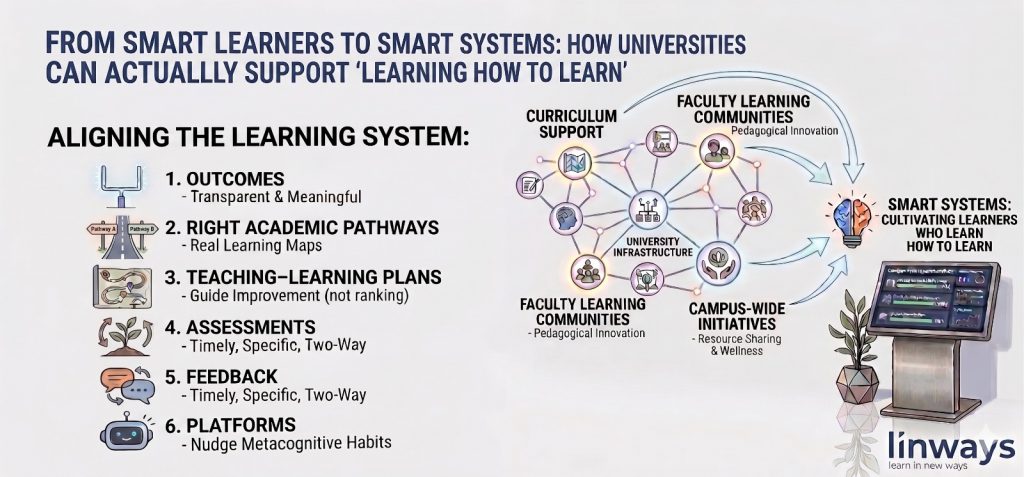
4. Using Assessments to Build Learning, Not Just Measure It.
Assessments are the strongest “signal” in any education system. Students naturally align their behavior to whatever is measured.
To support “learning how to learn,” institutions need to balance:
- Formative assessments: low-stakes checks during learning.
- Summative assessments: high-stakes evaluations at the end.
- Other assessments: projects, portfolios, presentations, peer reviews, and practicals.
Smart systems can make assessments work for learning:
- Frequent low-stakes quizzes with feedback help students check if they really understand.
- Rubrics linked to outcomes show why they scored a certain way and what to improve.
- Project-based assessments give room for goal setting, planning, and reflection in context.
Instead of a single exam becoming the final verdict, assessment becomes an ongoing conversation between the learner, the teacher, and the system.
Read More about: Assessment strategies in higher education: How do we truly accommodate every student?
5. Feedback as a Habit, Not an Event
Feedback is often collected as a formality from students to teachers at the end of the course, or from teachers to students, only as marks.
To support smart learning, feedback needs to be:
- Timely: close to the activity, not weeks later.
- Actionable: telling students what to change, not just what they did wrong.
- Two-way: students giving feedback on what helps them learn, and teachers adjusting their methods.
A well-designed platform can:
- Prompt students to reflect after each assessment: “What went well? What will you do differently next time?”
- Allow teachers to share short, focused comments attached to outcomes.
- Aggregate faculty feedback so they can see patterns and refine their TLPs.
In this way, feedback becomes part of the loop: plan → act → check → reflect → adjust.
Read More about: How to Build a Feedback-Driven Campus with Higher Student Participation.
6. Platforms as Invisible Enablers of Metacognition
Technology should not replace the teacher or the learner, but it can quietly support good habits.
A smart academic management platform can:
- Surface learning goals (POs, COs) inside daily activities.
- Nudge students to set simple session goals (“What are you trying to learn today?”).
- Ask metacognitive questions after key tasks (“Does this really make sense to you?”).
- Offer reflection prompts at the end of the week or module.
Over time, these small prompts help students internalize the behaviors we described in the first blog: setting objectives, checking understanding, and reflecting. The system becomes an ally that reminds, organises, and visualises learning, while teachers bring human guidance and context.
Conclusion: Aligning People, Process, and Platform
In Designing Smart Learners, we focused on the individual: how a student can think, plan, and reflect to learn better.
In this article, we shifted the lens to the system: How can institutions and platforms make these behaviors easier, more natural, and more consistent?
The answer lies in aligning:
- Outcomes that are transparent and meaningful.
- Teaching–Learning Plans that act as real learning maps.
- Assessments that guide improvement, not just ranking.
- Feedback that is timely, specific, and two-way.
- Platforms that nudge and support metacognitive habits every day.
When these elements work together, students are not left alone to “figure out” learning. The environment itself teaches them how to learn.
In the next article, we will explore Metacognition in Two Levels: Metacognitive Knowledge and Metacognitive Skills, and see how institutions can help students build both, step by step.
Book a personalized walkthrough with our higher education specialists.
Next Blog: Metacognition in Action: Building Learners Who Can Guide Their Own Learning
Read the previous blog on the topic: Designing Smart Learners: Helping Students Learn How to Learn.