
The Science of Experience.
This is the seventh blog in the Designing Smart Learners series. In this article, we explore the science behind experiential learning.
In modern education, teaching must move beyond the mere transmission of information to foster critical thinking and real-world application. Research consistently shows that active engagement enhances cognitive processing and long-term retention far more effectively than passive instruction. David A. Kolb’s Experiential Learning Theory provides a powerful framework for this shift, transforming how students move from “knowing” to “doing.”
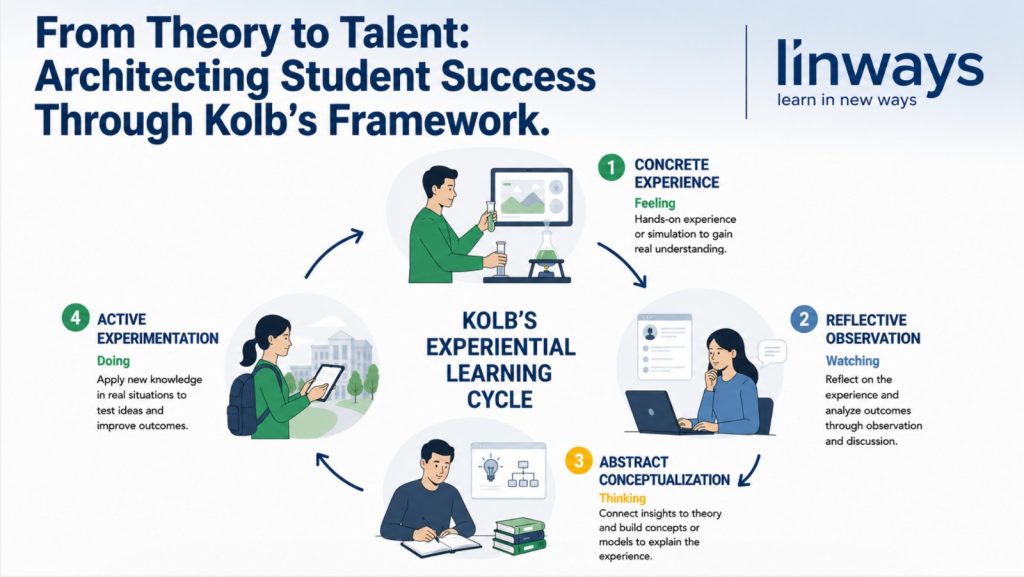
The Four Stages of the Experiential Learning Cycle
Kolb’s model is built on a structured four-stage cycle where knowledge is developed through a continuous loop of feeling, watching, thinking, and doing.
1. Concrete Experience (CE) – “Feeling.”
This is the “doing” phase where learners engage in a real or simulated situation to gain firsthand understanding.
- The Goal: Moving beyond reading to active participation.
- Strategy: Implement hands-on labs, field work, clinical rotations, or role-playing exercises that allow students to encounter a subject physically or emotionally before diving into the theory.
2. Reflective Observation (RO) – “Watching.”
Learners critically review their experience, analyzing responses and outcomes to gain deeper insight.
- The Goal: Promoting self-awareness and cognitive processing through discussion and review.
- Strategy: Facilitate structured debriefing sessions, peer-group discussions, or reflective journaling where students examine their performance and the perspectives of others.
3. Abstract Conceptualization (AC) – “Thinking.”
At this stage, learners interpret their reflections to develop logical theories or principles that explain the experience.
- The Goal: Strengthening analytical reasoning by connecting practice to theory.
- Strategy: Guide students to build concept maps, create logical models, or write research papers that link their firsthand observations to established academic frameworks.
4. Active Experimentation (AE) – “Doing.”
In the final stage, students apply their newly developed ideas to practical situations to refine their understanding.
- The Goal: Improving professional competencies and real-world problem-solving.
- Strategy: Assign project-based capstones, community-based service learning, or internships where students must test their theories in complex, unpredictable environments.
Learning Styles in Kolb’s Experiential Learning Theory
David A. Kolb proposed that learners develop preferences for acquiring and processing information based on combinations of the four stages of experiential learning.
1. Diverging Style (Concrete Experience + Reflective Observation)
These learners are imaginative, reflective, and capable of viewing situations from multiple perspectives.
Effective Strategies
- Group discussions
- Brainstorming activities
- Observation-based and reflective tasks
2. Assimilating Style (Reflective Observation + Abstract Conceptualization)
These learners prefer logical analysis, conceptual understanding, and structured information.
Effective Strategies
- Video lectures and digital texts
- Theory-based modules
- Concept mapping tools
3. Converging Style (Abstract Conceptualization + Active Experimentation)
These learners are problem-oriented and prefer practical application of concepts and technical skills.
Effective Strategies
- Simulations and virtual experiments
- Application-based assessments
- Technical learning platforms
4. Accommodating Style (Concrete Experience + Active Experimentation)
These learners prefer hands-on involvement, action-based learning, and practical experiences.
Effective Strategies
- Project-based assignments
- Interactive workshops
- Experiential virtual environments
Why It Matters for Higher Education
Integrating Kolb’s model into the academic journey strengthens students’ analytical and adaptive competencies. By aligning these stages with effective digital platforms, universities create a student-centered ecosystem where learning becomes not just a requirement, but a lifelong, self-directed habit.
So far, we have looked at
- Designing Smart Learners: Helping Students Learn How to Learn.
- From Smart Learners to Smart Systems: How Universities Can Actually Support “Learning How to Learn”
- Metacognition in Action: Building Learners Who Can Guide Their Own Learning
- How the Brain Turns Learning into Knowledge and Skill.
- Knowledge to Skill to Habit: Designing for the Full Learning Loop.
- The Architecture of Learning: Leveraging Learning Theories for Student Success.
Book a personalized walkthrough with our higher education specialists.