
In our “Designing Smart Learners” series, we have looked at how individuals can guide their own learning (Blog 1 and Blog 3) and how systems can support them (Blog 2). In this article, we go one level deeper into the brain itself.
If learning is a behavior that can be designed, what happens inside the brain when a student moves from “hearing something” to “truly knowing it” and “being able to do it”? And how can institutions help students use this science to learn more effectively?
To answer that, we need to look at two ideas together:
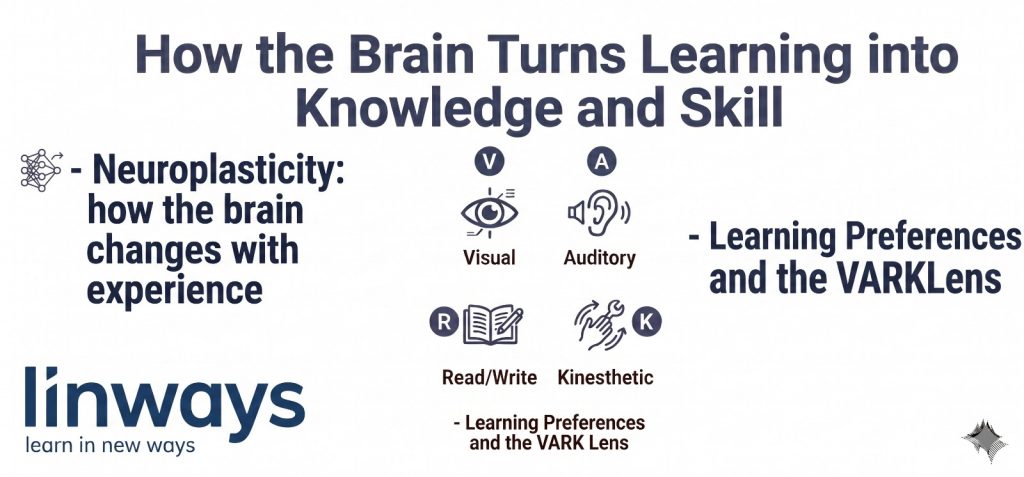
- Neuroplasticity: how the brain changes with experience.
- Metacognition: how learners observe and adjust their own learning.
When we connect these, we begin to see how the brain literally rewires itself when students learn how to learn.
Neuroplasticity: The Brain’s Ability to Change Itself
Neuroplasticity is the brain’s ability to reorganise its structure, functions, and connections in response to experience, learning, or injury. It is the foundation of all learning.
Every time a student tries a new problem, practices a concept, or reflects on what went well and what did not, tiny changes happen in their brain. Connections between neurons are strengthened, weakened, or rebuilt. Over time, these changes turn temporary understanding into stable knowledge and usable skill.
Two main forms of neuroplasticity are especially important for learning:
- Structural plasticity: The brain physically changes its structure in response to learning. New synapses are formed, existing synapses become stronger or weaker, and in some cases new neurons are created. A classic example is musicians developing a thicker auditory cortex because of years of focused listening and practice.
- Functional plasticity: The brain can shift functions from one region to another when there is damage or weakness. This is seen in stroke recovery or when one sense compensates for another. Neural pathways are re-routed to keep key functions alive.
In everyday learning, we have to remember a simple rule:
Connections between neurons become stronger with use or practice, and weaker when not used.
In other words: “use it or lose it” is not a slogan; it is how the brain operates.
Learners’ preferences and the VARK Lens
Many learners describe themselves as visual, auditory, reading/writing, or kinesthetic learners. The VARK model is not a rigid scientific classification, but it offers a simple way to see how different experiences may drive different patterns of brain activity:
- Visual learners: Prefer diagrams, images, charts, and spatial layouts. They lean more on areas of the brain responsible for visual processing.
- Auditory learners: Learn better through listening to lectures, discussions, or audio. Their auditory pathways are engaged more deeply and more often.
- Read/write learners: Gravitate towards text, notes, and writing. They use language and analytical areas heavily.
- Kinesthetic learners: Learn by doing-labs, projects, simulations, physical movement. Their motor systems and sensory feedback loops are more involved.
Modern research suggests that most people are not purely one type. A large majority of learners are multimodal-they benefit from a combination of visual, auditory, reading/writing, and kinesthetic inputs. This actually fits well with neuroplasticity: the more diverse, meaningful, and repeated the signals, the more robust the brain changes.
This also changes how we think about “intelligent” learners. Some students seem to “get it” in one reading; others struggle through multiple repetitions. It is easy to label this as “smart vs not smart”. In reality, it is often a mismatch between:
- The pathways the brain is currently comfortable with, and
- The way the content is presented and practiced.
If a learner understands how they learn best, they can choose methods that align with their dominant modes and then gradually strengthen the others. Instead of hard work without direction, they can work smart by using their natural preferences to drive faster, deeper changes in the brain.
Key Principles of Neuroplasticity in Learning
Several practical principles explain how neuroplasticity turns learning experiences into knowledge and skill:
- Use it or lose it
Neural connections that are used frequently become stronger and more efficient. Those that are rarely activated are pruned away. For a student, this means that only attending class or reading once is not enough; the brain needs repeated, active engagement with the ideas. - Active effort and focus
Children’s brains are rewired passively by their environment. In adults and older students, change requires more conscious effort. Focused attention, deliberate practice, and metacognitive checks (“Do I really understand this?”) tell the brain, “This is important-keep this connection.” - Novelty and complexity
New and challenging tasks, such as learning a new language, starting a new instrument, or solving a new type of problem, drive more intense neural activity. The brain has to build or stretch pathways instead of just replaying old ones. Learning that is just repetitive without challenge contributes less to long‑term adaptation. - Repetition and consistency
Without repetition, even strong experiences fade. Consistent practice over time consolidates neural changes so that knowledge moves from “temporary understanding” to “long‑term competence”. This is why spaced practice and revisiting concepts matter more than last‑minute cramming. - Motivation and emotion
Motivation, curiosity, and positive emotion amplify neuroplastic changes. When a student cares about a goal, sees progress, and receives constructive feedback, the brain is more ready to strengthen and stabilize new connections. Stress, anxiety, and chronic fear, on the other hand, can crowd out the cognitive space needed for reflection and integration.
These principles are not abstract. They are the bridge between everyday learning behaviours and the actual wiring of the brain.
Metacognition and Neuroplasticity: A Positive Feedback Loop
In earlier blogs, we saw metacognition as:
- Metacognitive knowledge: What I know about how I learn-my strengths, weaknesses, and helpful strategies.
- Metacognitive skills: What I actually do while learning, planning, monitoring, and evaluating.
When students use metacognition, they do not just follow instructions; they actively steer their own learning. They set a goal, choose a strategy, check if it is working, and adjust. This is exactly the kind of deliberate, focused, repeated activity that drives neuroplasticity.
In simple terms:
- Better metacognitive skills appear to promote neuroplastic changes that support improved attention, memory, and cognitive flexibility.
- Those brain changes, in turn, make it easier for learners to plan, monitor, and adjust their learning in the future.
Evidence from research suggests that people who regularly engage in metacognitive practices-mindfulness, self‑questioning, planning their learning, and reflecting after tasks-can show structural and functional changes in brain regions linked to self‑monitoring and control. Over time, this creates a positive feedback loop:
- Learners become more aware of how they learn.
- They choose and refine strategies that match their tasks and preferences.
- The brain adapts structurally and functionally to support these strategies.
- It becomes easier to manage attention, memory, and effort.
- Learners can engage in more advanced metacognitive behaviours.
When a student accomplishes what felt out of reach previously, that is not just a matter of motivation or luck. It is neuroplasticity at work, shaped by metacognitive practice and a growth mindset.
In the next blog of this series, “Designing Smart Learners” – Learning How to Learn series, we will dive deeper into how knowledge transforms into skill, and how cognitive abilities develop into psychomotor capabilities.
- Designing Smart Learners: Helping Students Learn How to Learn.
- From Smart Learners to Smart Systems: How Universities Can Actually Support “Learning How to Learn”
- Metacognition in Action: Building Learners Who Can Guide Their Own Learning
Book a personalized walkthrough with our higher education specialists.