
We all expect students to become independent, self-directed, and lifelong learners. But independence does not develop simply because we ask students to take responsibility. It develops when learners gradually experience autonomy, the ability to make meaningful choices, take ownership, and influence how they learn.
What is autonomy?
Autonomy is the feeling that “I have some control over what I do and how I do it.”
It does not mean complete freedom or the absence of guidance. Learners still need clear goals, boundaries, feedback, and support. Autonomy means having meaningful choices within that structure.
For example, instead of asking every student to complete the same project in exactly the same way, a university could define the learning outcome and allow students to choose a relevant topic or appropriate format to demonstrate their understanding.
The goal is to move from:
“I am doing this because I have been told to.”
to
“I understand why I am doing this, and I have some ownership of how I approach it.”
Why does autonomy matter in learning?
Learning requires attention, effort, practice, reflection, feedback, and adjustment. When students have some control over these processes, they become more active participants in their learning.
William Stixrud & Ned Johnson in their book, ‘The Self- driven Child’ portrays that a sense of control reduces chronic stress and lets the prefrontal cortex (planning, judgment, self‑control) function properly.
An autonomous learner begins to ask:
- What do I need to learn?
- What do I already know?
- Which strategy might work best?
- How will I know whether I have learned it?
- What should I change if my strategy is not working?
That directly relates to metacognition, neuroplasticity, attention, and motivation; those systems only work well when the brain is not stuck in threat/survival mode.
Autonomy therefore shifts learning from something managed for the student to something the student gradually learns to manage independently.
Autonomy Needs Structure
Autonomy should not be confused with letting students do whatever they want.
Students need clarity about:
- What are they expected to learn?
- Why does it matter?
- What standards do they need to meet?
- How will learning be assessed?
Within these boundaries, universities can provide meaningful choices.
Clear goals + Safe choices + Consultant support = A self driven mind
The structure provides direction; autonomy provides ownership.
Autonomy and the Four Stages of Competence
The development of autonomy can also be viewed through the Four Stages of Competence.
1. Unconscious Incompetence
“I don’t know what I don’t know.”
Students may not recognise gaps in their knowledge or ineffective learning strategies.
Autonomy cannot exist without self-awareness, so the goal here is to trigger that awareness. Diagnostic assessments, reflection, and feedback can help them identify these gaps.
Autonomy begins with awareness.
2. Conscious Incompetence
“I now know what I don’t know.”
The student recognizes their shortcomings but lacks the immediate solution. Instead of spoon-feeding answers, educators can use coaching questions to pass the ownership of problem-solving to the learner, turning a mistake into a collaborative strategy session.
A student may realise:
“I studied this topic, but I couldn’t apply it in the assessment.”
Instead of immediately providing the solution, educators can ask:
“What do you think went wrong? What could you try differently?”
The learner begins to participate in deciding how to improve.
Awareness becomes ownership.
3. Conscious Competence
“I can do it, but I need to understand it in my own way.”
The learner understands an effective strategy but still needs conscious effort.
For example, a student may learn that retrieval practice works better for long-term retention than simply rereading notes. They now need to deliberately practise retrieval and monitor their progress.
The university provides resources, practice, feedback and guidance, while the learner increasingly decides how to use them.
Autonomy grows through practice and decision-making.
4. Unconscious Competence
“I can do it naturally.”
With practice, effective learning behaviours become increasingly automatic.
The learner can:
Identify → Choose → Apply → Monitor → Reflect → Adjust
without needing constant external direction.This is where competence develops into self-directed learning.
Without repetition, even strong experiences fade. This is due to neuroplasticity, the brain’s ability to rewire itself. Consistent practice over time consolidates these neural changes, strengthening synaptic connections so that knowledge moves from a “temporary understanding” to “long‑term competence.” This is why spaced practice and revisiting concepts matters more than last‑minute cramming.
Autonomy and Intrinsic Motivation
Autonomy is closely connected with Self-Determination Theory (SDT), developed by Edward Deci and Richard Ryan.
The theory identifies three basic psychological needs that support high-quality motivation:
Autonomy – “I have meaningful control over my actions.”
Competence – “I can develop and improve.”
Relatedness – “I feel supported and connected.”
When these needs are supported, learners are more likely to internalise the value of learning and develop more self-directed forms of motivation.
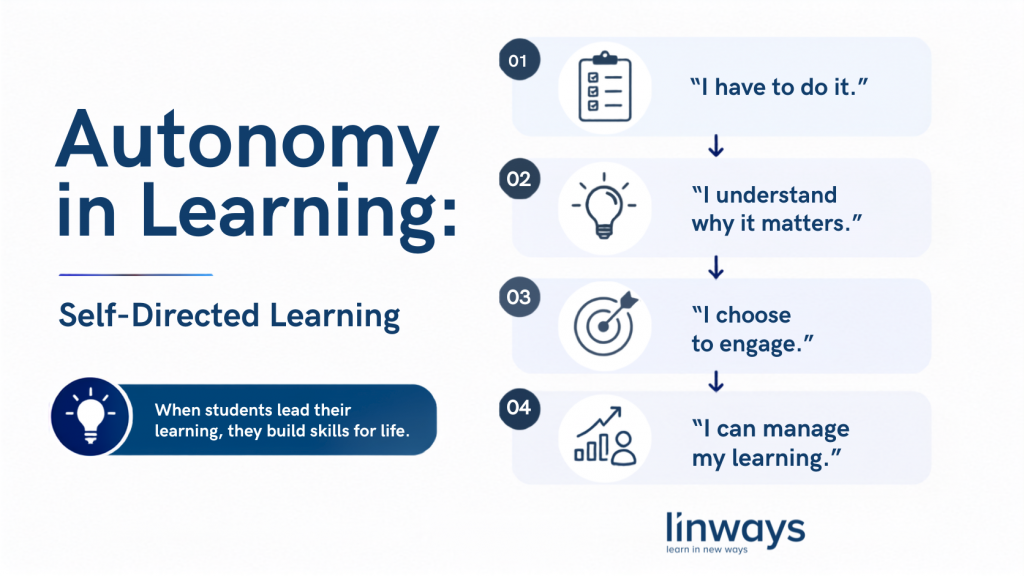
A student’s mindset shifts naturally as they gain independence. It begins with basic compliance and the feeling of, “I have to do it.” Once the purpose becomes clear, they find meaning in the task realizing, “I understand why it matters.” This clarity sparks internal motivation, moving them to a place of personal choice where they can say, “I choose to engage.” Finally, as good habits become automatic, they take total ownership of their growth and confidently declare, “I can manage my learning.”
This is important in education because the goal is not only successful course completion but the development of learners who continue learning beyond university.
Designing an autonomy-supportive environment involves integrating meaningful choices, fostering a safe-to-fail culture, and providing actionable, forward-looking feedback mechanisms. By explicitly teaching cognitive strategies, communicating the purpose behind tasks, and progressively releasing control from teacher-directed to self-directed, the environment empowers learners to take ownership of their development.
From Autonomy to SMART Learners
This brings us back to the central idea of “Learning Is a Learned Behaviour.”
A SMART learner is not simply someone who achieves high grades. A SMART learner increasingly knows how to:
S – Self-aware: Recognise learning needs and gaps.
M – Motivated: Understand purpose and find meaning in learning.
A – Autonomous: Make informed choices and take ownership.
R – Reflective: Learn from feedback, mistakes, and experience.
T – Transferable: Apply learning across different situations.
The journey is:
Structure → Choice → Ownership → Competence → Self-Regulation → Autonomy → Lifelong Learning
The role of a university is therefore not only to teach students what to learn, but also to help them develop the capacity to decide how to learn, monitor their progress, adapt their strategies, and continue learning independently.
When learners gradually gain the knowledge, confidence, and freedom to direct their own learning, they move from being students who complete tasks to learners who take ownership of learning.
That is the foundation of becoming a SMART learner and ultimately, a lifelong learner.
Book a personalized walkthrough with our higher education specialists.