
How to help students shift from reacting to exams to actively steering their own learning.
In the first article, Designing Smart Learners, we explored how individuals can set goals, check their understanding, and reflect on what they learn. In the second, From Smart Learners to Smart Systems, we saw how universities and platforms can support these behaviors through Academic Pathways, Outcomes, TLPs, Assessments, and Feedback.
This third article goes one level deeper.
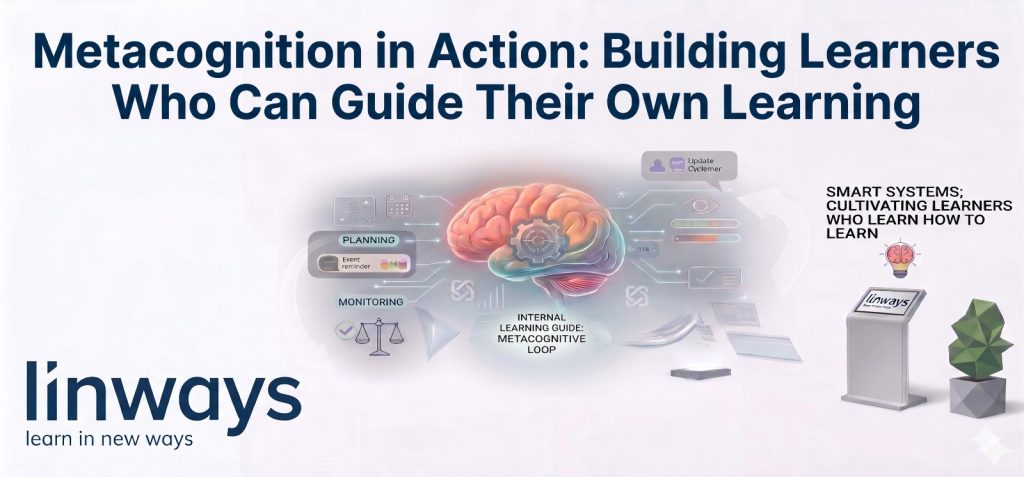
If we want students who can truly “learn how to learn,” we need to help them understand and practice metacognition at a much more intentional level. Metacognition is not just a nice idea or a buzzword; it is a concrete set of knowledge and skills that can be taught, observed, and strengthened over time. In this article, we break metacognition into two parts: metacognitive knowledge and metacognitive skills, and show how institutions can design simple experiences that build both.
What Is Metacognition, Really?
At its core, metacognition is “thinking about one’s own thinking.”
It is the difference between:
- A student who says, “I studied this chapter,” and
- A student who says, “I realised I only understood the definitions, not the applications, so I changed my method.”
Metacognition helps learners move from reacting to exams and assignments to actively steering their own learning. To operationalise it, we can look at it in two levels:
- Metacognitive knowledge – what I know about how I learn.
- Metacognitive skills – what I actually do while learning.
Both are essential. Knowledge without action leads to insight but no change. Action without knowledge becomes trial and error.
1. Metacognitive Knowledge: “How Do I Learn Best?”
Metacognitive knowledge is the awareness a learner has about:
- Themselves as a learner
- Different strategies available to them
- The tasks and conditions under which they learn best
This includes questions like:
- What are my strengths and weaknesses when I learn?
- Do I concentrate better in the morning or evening?
- Do I remember more when I write, teach someone else, or create diagrams?
- In which subjects do I tend to make careless mistakes?
- What Type of Learner I Am?
How institutions can build Metacognitive Knowledge
Colleges can help students develop this self-knowledge through small but deliberate practices:
- Short self-assessment surveys at the start of each semester (“How do you usually study?” “What type of content helps you learn best?”).
- Reflection prompts after major assessments (“Where did I lose marks—concept, application, or attention?”).
- Simple nudges shared by faculty or AI based on previous data (“For this topic, try practice problems, concept maps, teaching a friend, etc.”).
- Peer discussions where students share “what worked for me” instead of only sharing notes.
When this is captured inside a platform, patterns become visible over time. That awareness is the foundation of metacognitive knowledge.
2. Metacognitive Skills: “What Do I Do While Learning?”
Metacognitive skills are the actions students take before, during, and after learning:
- Planning – deciding what, how, and how long to study
- Monitoring – checking understanding while learning
- Evaluating – reviewing what worked and what did not
These skills can be as simple as:
- Before studying: “What is my goal for this 30 minutes?”
- During studying: “Can I explain this in my own words without looking?”
- After studying: “What still feels unclear? What will I do differently next time?”
How institutions can build metacognitive skills
Metacognitive skills grow through repeated practice in real contexts, not separate “theory” sessions. Faculty and systems can:
- Begin a class with a one-line planning prompt: “Write what you want to understand by the end of this session.”
- Pause mid-lecture for a 2-minute self-check: “On a scale of 1–5, how well do you understand this idea?”
- End labs, projects, or exams with two questions: “What worked?” and “What will you change next time?”
On a platform, these can be embedded as tiny nudges:
- A small box before an online quiz: “What is your target score? What will you do if you don’t reach it?”
- A short reflection form after submissions: “Which part took the most time? Why?”
- Weekly dashboards that not only show marks but also ask, “What pattern do you see in your performance this week?”
Over time, these micro-actions become habits. The learner is no longer just doing tasks—they are managing their own learning.
Bringing Knowledge and Skills Together
Metacognitive knowledge and skills reinforce each other:
- Knowledge without skills: “I know I get distracted, but I don’t change anything.”
- Skills without knowledge: “I try many methods but don’t know which one truly suits me.”
When both are present, a different kind of learner emerges:
- They know their typical mistakes and blind spots.
- They can choose strategies that fit the subject and situation.
- They can explain how they learned something, not just what they learned.
Institutions can design for this by:
- Helping students name their learning strategies and preferences.
- Giving them structured spaces to plan, monitor, and reflect in every course.
- Using a platform to make these patterns visible over time for the learner, the teacher, and the institution.
Why This Matters for the Future of Education
If education is only about delivering content, then metacognition will always be treated as an optional add‑on rather than an integral part of learning.
But if education is about preparing people for a world where they must constantly adapt, reskill, and reinvent themselves, then metacognition becomes central.
“A graduate who can guide their own learning is far more valuable to themselves, to employers, and to society.”
For an institution, this means success is not only:
- How many students passed, but
- How many students leave with the ability to teach themselves the next thing or progress to the next level as lifelong learners?
When we design systems that build metacognitive knowledge and skills, we move closer to that vision.
What Comes Next
In this article, we unpacked metacognition into two levels and explored how both can be nurtured through everyday academic practice.
Next, we need to deep dive into how Metacognition and Neuroplasticity and how it is closely linked: metacognition can drive neuroplastic changes, and neuroplastic changes can, in turn, strengthen metacognitive abilities.
In the next part of this series, we will look at different types of learners and neuroplasticity, and how systematic practices can help every learner make “learning how to learn” a part of their daily routine, not just an occasional workshop.
Read our previous blogs on Designing Smart Learners:
- Designing Smart Learners: Helping Students Learn How to Learn.
- From Smart Learners to Smart Systems: How Universities Can Actually Support “Learning How to Learn”
Using a good academic management platform helps institutions lay the foundation for this. With a research-backed AMS like Linways , institutions can run targeted surveys, enable mentor–mentee interactions designed with metacognition in mind, and use AI features that support reflective learning. Assessments can be used to understand students’ knowledge, skills, and attitudes, and to help them turn these practices into a habit.
Next Blog: How the Brain Turns Learning into Knowledge and Skill.
Book a personalized walkthrough with our higher education specialists.