
Most learners try to learn new skills using raw willpower.
They make rigid promises to themselves: “I’ll study coding for two hours every night after my class hours, and then burn out by day three. The pattern repeats with every new goal: a strong start, a few good days, then exhaustion, distraction, and guilt.
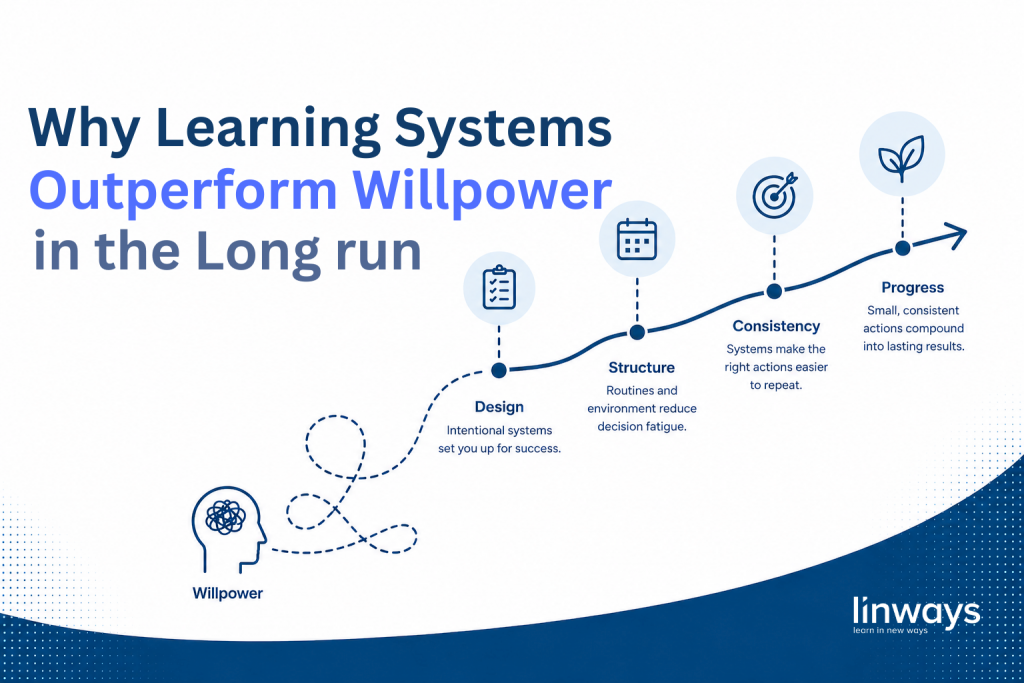
Smart learners operate differently.
They don’t trust motivation. They assume it will disappear. Instead, they design simple, reliable systems that keep them moving forward even on the days when they feel tired, lazy, or distracted.
This blog explains how to do that, drawing on the research of learning coach Justin Sung.
1. Expect Failure: Design for your worst days, not your best
Most study plans are secretly written for an imaginary version of you, someone who is always fresh, focused, and disciplined.
Real life does not work like that.
Smart learners start by assuming that they will be:
- Tired after work or college hours
- Distracted by their phone
- Pulled into family, social, or other demands
- Mentally flat on many evenings
So instead of asking, How can I be more motivated?, they ask a better question:
Why did my last plan fail?
Look back at your previous goals:
- When you tried to learn a new language, did you quit because you were mentally drained by 7:00 PM?
- When you planned to read every night, did your phone always win your attention?
- When you started an online course, did you stop the moment when other priorities increased?
Write these reasons down. They are not moral failures. They are design constraints.
Then, plan around them instead of pretending they don’t exist. If your brain is tired after dinner, don’t schedule your hardest learning task at 9:30 PM. If your phone derails you every time, don’t keep it in your hand and hope you’ll be strong.
Smart learners are honest about their patterns, and then build systems that work with them, not against them.
2. Pass the worst-day test: Make your plan survive laziness
A learning plan that only works when you dig deep will fail the moment life gets hard.
A better rule:
If your plan doesn’t work on your laziest day, it’s not a real system.
The key is to reduce friction so much that even a tired, unmotivated version of you can execute it.
Change the environment, not your personality
The environment quietly decides most of your behaviour. For example:
You want to master data analytics.
- Traditional Plan:
Most people follow the same loop after work: they reach home, sink into the couch, tell themselves they’ll just rest for a minute, open their phone, start scrolling or watching Netflix, and the evening disappears before the laptop ever opens.
The problem: this plan depends on a huge willpower surge at the exact moment your energy is lowest.
- Systemic Plan:
Pack your laptop, head straight to a quiet library for 45 focused minutes after work, and only then go home.
The environment now does the heavy lifting. Once you are seated in a quiet space with your laptop open, the path of least resistance is to start practicing.
The difference is not discipline; it is design. Your system should make the right action feel like the easiest action available.
3. Fix the root cause: Don’t live on band‑aids
When we start a new habit, we often use tools to force focus: phone‑locking apps, endless Pomodoro timers.
These can be useful, but according to the author, they are band‑aids, not cures.
Systemic learners use them temporarily, then ask, Why do I need this crutch in the first place?
Two common root causes:
- Digital overload
If your attention span is shattered because you scroll social media all day, no app can fully save your focus. You need a system that reduces baseline distraction:- Fewer apps on your phone
- No social media during certain blocks of the day, as we discussed in Deep Work.
- Phone out of reach while learning
- Fewer apps on your phone
In other words, rebuild your biological ability to focus; don’t just patch over it.
- Chronic fatigue
If you constantly fall asleep over your notes, the real issue is not a lack of willpower; it is sleep and recovery. Another coffee, another energy drink, or another study playlist only stretches a broken foundation.
The author says to fix your sleep hygiene, stress, and basic health before demanding more focus from your brain.
Use tools, but don’t let your whole system become a pile of hacks instead, treat symptoms and sources.
Temporary discomfort vs. Permanent stagnation
Changing your routine will feel uncomfortable.
Staying an extra hour at a library instead of going straight home to relax will feel annoying at first. Turning off notifications, leaving your phone in another room, or saying no to yet another late‑night scroll will feel restrictive.
But compare that to the long‑term discomfort of:
- Staying stuck in the same grade or semester for years
- Repeating the same exam without improving your marks
- Watching internships, scholarships, and placements pass by because your skills never moved forward
Smart learners choose short‑term friction to avoid long‑term regret.
They don’t wait for motivation to appear. They fix the environment, lower friction, remove band‑aids, and let the system quietly carry them forward even on the days they feel least like trying.
In the end, it is not the loud promise, From tomorrow, I will change my life that matters.
It is the quiet design: a small, repeatable system that still works when you are tired, distracted, and human.