

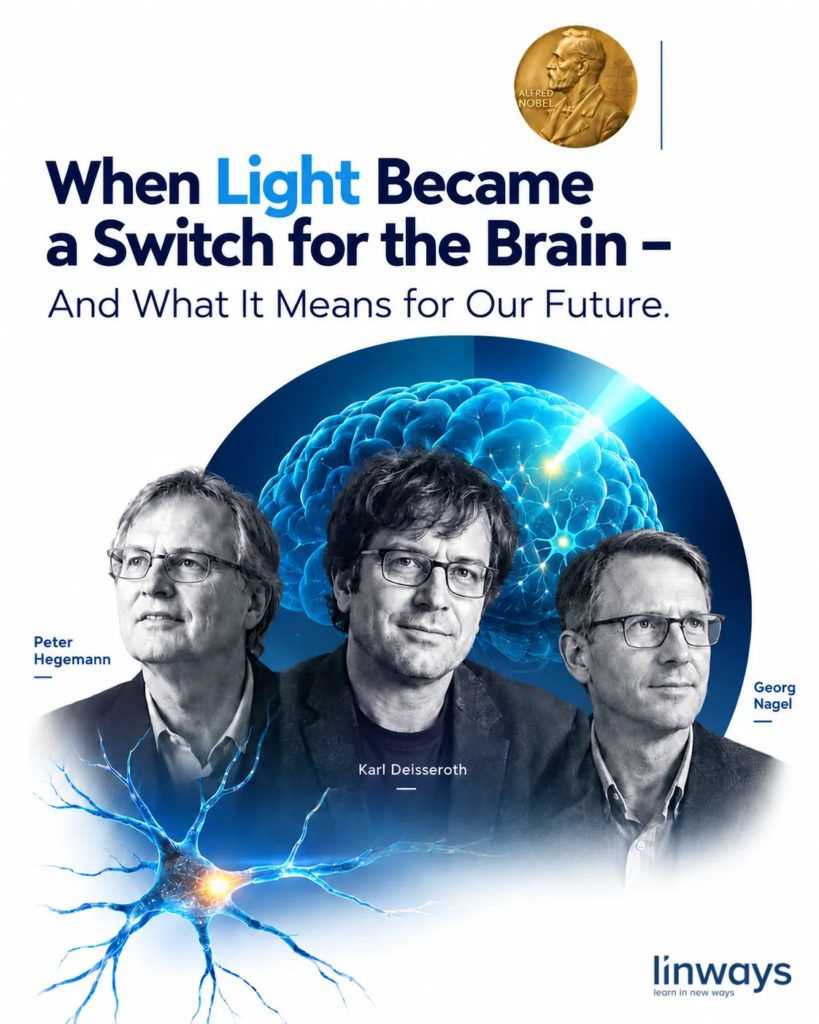
In October 2026, a quiet revolution in brain science received the world’s biggest spotlight. The Nobel Prize in Physiology or Medicine was awarded to Karl Deisseroth, Peter Hegemann and Georg Nagel for something that sounds like science fiction: using light to switch brain cells on and off.
The technique is called optogenetics, and it is already reshaping how we understand the brain. But its real impact may lie in what it lets us do with the brain in the decades ahead from decoding memories to designing safer brain-computer interfaces.
This is the story of how a tiny alga changed neuroscience, and how that discovery may change the story of human brains in the future.
From a Single-Celled Algae to the Human Brain
The journey does not begin in a lab filled with high‑tech brain scanners. It begins in water, with a microscopic, single‑celled alga called Chlamydomonas.
These algae have a simple problem: they need to sense light to move towards it. To do this, they use special proteins in their cell membrane called channelrhodopsins. When blue light hits these proteins, they act like tiny switches. They open a channel in the membrane, charged particles rush in, and an electrical signal is created. The alga “feels” the light and swims.
Peter Hegemann and Georg Nagel figured out how these light-sensitive proteins worked. Then came the pivotal insight: if you could take the gene for channelrhodopsin and put it into another kind of cell, that cell too would become sensitive to light.
Now imagine doing that not in algae, but in nerve cells.
The Moment Brain Cells Got a Light Switch
Karl Deisseroth, a psychiatrist and bioengineer, took this idea into the brain. His team put the channelrhodopsin gene into neurons from rats. When they shone blue light on those neurons, the cells fired electrical signals on command.
Soon, the same method worked inside the brains of living mice. Scientists placed very thin optical fibres into the brain. By sending light through those fibres, they could turn very small groups of neurons on or off at very precise times, even down to a few thousandths of a second.
This is the core idea of optogenetics:
- Use genetic tricks to make selected neurons produce light‑sensitive proteins.
- Shine carefully controlled light onto exactly those neurons.
- Watch what happens to behaviour, memory or emotion when those neurons are turned on or off.
Before this, scientists mostly watched brain activity and tried to guess what it meant. Now they could change activity in one part of a network and see what changed in the animal. That helps move from “these cells are active when the animal is afraid” to “these cells help cause the fear”.
What We’ve Learned So Far
Optogenetics has already changed basic brain research.
Using this method, scientists have:
- Activated neurons that hold a specific fear memory in mice and watched the fear return when those cells light up again.
- Turned on reward‑related neurons and seen animals repeat behaviours that trigger that activity.
- Mapped circuits involved in movement and shown how some of those cells misfire in diseases like Parkinson’s.
- Probed brain circuits related to social behaviour, anxiety, aggression and decision‑making.
In simple terms, this means we can now point to specific networks of neurons and say, “these ones are important for this behaviour or feeling”, not just “they were active at the same time”.
There are also early medical signs. In one study, an experimental optogenetic treatment helped a blind person with a retinal disease recover some visual function. Remaining retinal cells were made light‑sensitive again and paired with special goggles. It was not a full cure, but it showed that the basic idea can work in humans too.
All this leads to a bigger question: what might this allow us to do in the future?
The Future Brain: From Measuring to Gently Steering
In the 20th century, brain science focused on measuring the brain with tools like EEG, MRI and PET scans. In the 21st century, we may learn how to gently and precisely influence brain activity instead of just observing it. Optogenetics is one of the first technologies that points in that direction.
Sharper Treatments for Brain Disorders
Right now, many brain treatments are rough tools. Medicines spread through the whole brain and body. Electrical stimulation, like deep brain stimulation for Parkinson’s, affects larger brain areas. These can help, but they also bring side effects because they are not very selective.
Optogenetics suggests another way: first, use light‑based experiments in animals to find exactly which circuits go wrong in a certain disease. Then design therapies that focus only on those circuits.
In the future, this could inspire:
- More targeted treatments for Parkinson’s disease that affect only the movement‑related neurons causing tremors and stiffness.
- Smarter approaches for epilepsy that calm just the networks that start seizures.
- Better methods to influence brain circuits linked with depression, anxiety or addiction, once we know the specific patterns that truly drive the symptoms.
Optogenetics itself may not become a common everyday treatment. It needs gene delivery and hardware to bring light into the brain, which has safety and ethical issues. But it can act as a testing ground and a map. Once we know what to target and how, other tools such as focused ultrasound, improved electrodes or safer gene therapies can be tuned to copy the same helpful effects in a more practical way.
Smarter Brain-Computer Interfaces
Brain-computer interfaces (BCIs) read signals from the brain and use them to control things outside the body, like robotic arms, computer cursors or speech devices. Today’s BCIs mostly use electrical recordings. These are powerful but not very clean: one electrode can pick up signals from many neurons at once, which makes decoding harder.
The detailed maps created using optogenetics can guide much better BCIs over time:
- If we know which exact patterns in which circuits mean move my hand to the left or start speaking, we can teach BCIs to read intentions more clearly.
- In the future, some systems might both read and gently stimulate circuits, forming a loop: the brain sends commands out, and the device feeds helpful patterns back in to stabilize or support the brain.
We are still far from science fiction ideas like uploading or downloading thoughts. But combining optogenetic insight, better sensors and modern AI could make BCIs more accurate, reliable and safe.
New Ways to Think About Memory and Identity
Some of the most dramatic optogenetic experiments involve memory. Scientists have labelled neurons that were active when a specific memory formed, then re‑activated them later with light. In mice, this can:
- Bring back a fearful memory.
- Change the emotional tone of some memories.
Over time, this research could help us:
- Design therapies that gently reduce the power of traumatic memories in PTSD.
- Find ways to support weak memories in early Alzheimer’s disease.
But this also raises deep questions. If we can change the circuits behind a memory or emotion, how do we decide what is healing and what is changing who someone is? When does fixing a brain pattern become rewriting a person’s story?
These ethical questions must be faced long before any such techniques move beyond the lab.
Limits, Risks and Why Caution Matters
It is easy to hear “control neurons with light” and jump to “control people’s minds”. That is not what science allows today.
Important limits remain:
- Most work is still in animals. Human experiments are very few, very careful and highly regulated.
- Getting genes safely into specific brain cells and bringing light to deep brain regions without risky surgery are huge challenges.
- The brain is not a simple on/off machine. Thoughts and feelings come from large, complex networks. Even if we can control some cells well, understanding the whole system is still extremely hard.
For now, optogenetics is mainly a research method. Its biggest gift may be the knowledge it gives us about how the brain is wired and how its rules work. That knowledge can then guide other, safer tools in the future.
A Tiny Protein, A New View of the Brain
There is something almost poetic about this Nobel‑winning work. A light‑sensing protein from a tiny alga becomes a precise switch for some of the most complex cells in existence: human neurons. A basic discovery, made with no clear medical goal at first, opens a new path for treating brain disorders and understanding ourselves.
Today, optogenetics helps scientists trace how thoughts, feelings and memories rise from the activity of billions of neurons talking to each other. Tomorrow, the insights it provides could shape how we treat brain disease, how we build the brain-computer interfaces and even how we think about choice and identity.
We are still at the beginning. The brain still hides more secrets than truths. But with tools like optogenetics, we are no longer just listening to it from the outside. For the first time, we can gently flip a tiny light switch on a single cell and watch how patterns of activity and in some cases behaviour ripple outward.
In that faint flash of blue light, we see the future of brain science: not the power to fully control minds, but the growing ability to understand, protect and one day, more precisely heal the human brain.