
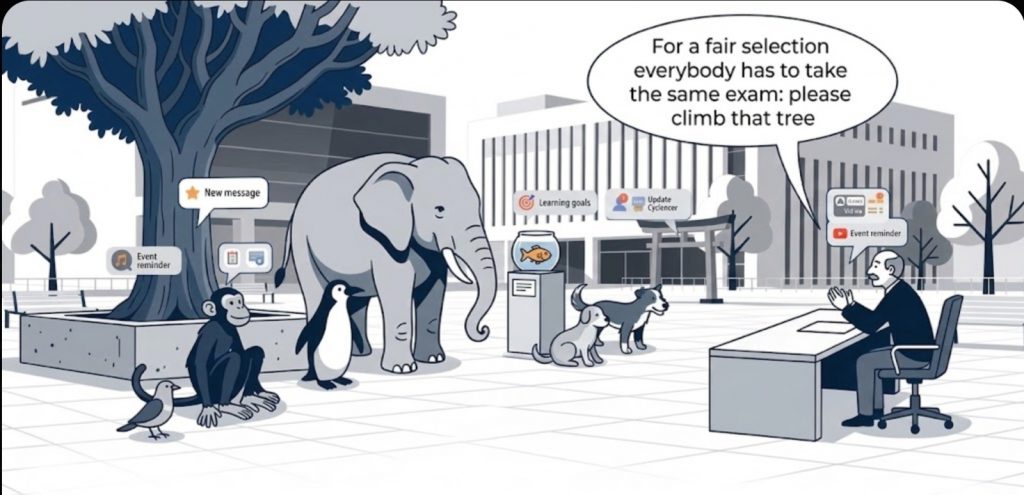
“Everybody is a genius, but if you judge a fish by its ability to climb a tree, it will live its whole life believing it is stupid .”
Introduction
When it comes to higher education or any education, each student comes with their own unique set of needs and abilities, and it is up to the educational institution to cater to those needs. To do so, they need to have a proper assessment strategy in place.
In today’s examination system, when we consider the bloom taxonomy, bottom-level memorization occupies a dominant place, while comprehension, application, analysis, synthesis, and evaluation are of less importance.
In most cases, this system isolates students from the quest for knowledge, the excitement of discovery, and the joy of learning
The Gap: Memorization vs. Mastery
Current examination systems often lean heavily on the bottom tier of Bloom’s Taxonomy: memorization. This focus isolates students from the joy of discovery and the excitement of learning.
- The Problem: Over-reliance on lower-order cognitive skills (Knowledge and Comprehension).
- The AICTE Recommendation: Institutions should cap lower-order skill weightage at 40%, pushing the remaining focus toward application, analysis, synthesis, and evaluation.
- The Industry Demand: Employers increasingly prioritize professional competencies and problem-solving over raw disciplinary knowledge.
- The large volume of classes and the lack of proper tools to design and execute different types of assessments to evaluate the higher order skills.
Why it is important for success for students and for institutions
The industry is more interested in professional skills than disciplinary knowledge. Further development of the subject requires disciplinary knowledge as well. Both need to be addressed. Both are useful for immediate placements, Research and lifelong success of the students
How can we address this?
Why do we need a Comprehensive Assessment Framework?
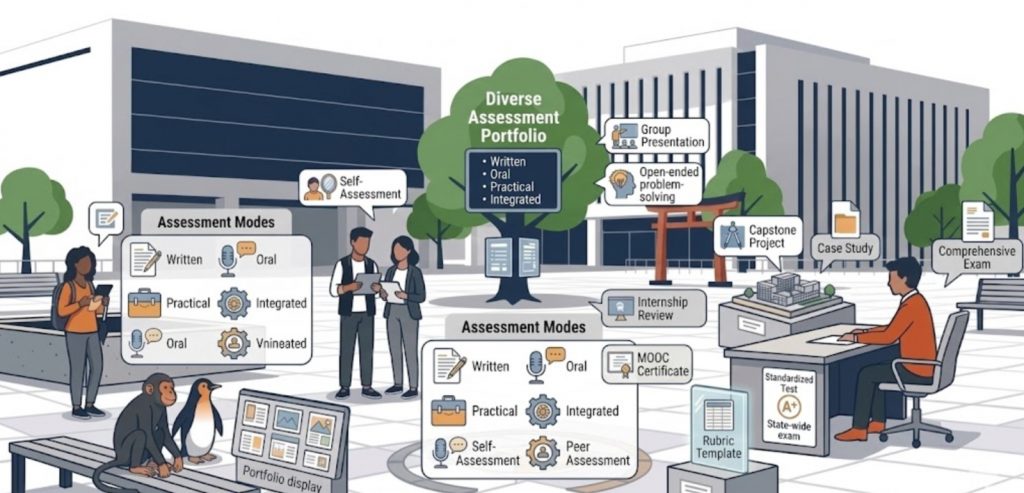
Written examinations alone will not suffice to assess student learning in courses where course outcomes (COs) cover a wide range of expectations. To ensure that assessment methods match learning outcomes, a variety of assessment methods should be employed e.g., Quizzes, Seminars, discussions, term papers, open-ended problem-solving assignments, course/lab project rubrics, portfolios, providing Rubrics, etc.
By combining outcome-based education and Bloom’s/Dave’s taxonomy, higher education institutions can create an effective assessment strategy to accommodate all students. Outcome-based assessment will ensure that all students are assessed based on the same criteria, while Bloom’s/Dave’s taxonomy will help teachers evaluate student learning more comprehensively. By using these two tools, higher education institutions can ensure that all students get the most out of their higher education experience.
To accommodate all learners, institutions must balance two primary assessment types:
1. Formative Assessment (Assessment for Learning)
These occur during the learning process to identify strengths and gaps in real-time.
- Benefits: Provides immediate feedback, reduces “test anxiety,” and increases student engagement.
- Examples: Peer/self-assessments, reflective journals, open-ended lab experiments, and classroom discussions.
2. Summative Assessment (Assessment of Learning)
These evaluate student mastery at the conclusion of a unit or semester.
- Benefits: Encourages mastery of the subject matter and provides a standardized measure of progress.
- Examples: Capstone projects, research papers, case studies, and standardized final exams.
Assessments are generally classifieds like the below table.
| Assessment Type | When to Use | Primary Goal |
| Diagnostic | Before instruction | Identifying gaps and starting points. |
| Ipsative | Throughout the course | Encouraging personal growth/motivation. |
| Norm-Referenced | Competitive entry | Ranking students against a large group. |
| Criterion-Referenced | Certification/Mastery | Ensuring specific standards are met. |
| Interim | At set intervals | Tracking institutional or district-wide progress. |
Broadening the Evaluation Scope
To move away from an exam-centric culture, the UGC suggests a multi-modal approach to evaluation:
| Mode | Examples |
| Written | Term papers, open-ended problem solving, essays. |
| Oral | Seminars, vivas, presentations. |
| Practical | Lab projects, portfolios, performance tasks. |
| Integrated | Internships, MOOCs, co-curricular experiences. |
The Approach (OBE + Bloom’s + Dave’s Taxonomy
By integrating Outcome-Based Education (OBE) with Bloom’s/Dave’s Taxonomy, institutions can create a transparent, goal-oriented framework.
Outcome-Based Education (OBE)
Start with the destination. Define Course Outcomes (COs) and Program Outcomes (POs) first, then design backward.
Bloom’s Taxonomy: Cognitive Domain
Design questions that progressively challenge higher-order thinking — from understanding to creation.
Dave’s Taxonomy: Psychomotor Domain
Classifies the Psychomotor Domain, focusing on physical skill development.
Steps to achieve
- Alignment: Every assessment must align with specific Course Outcomes (COs) and Program Outcomes (POs).
- Clarity: A well-defined assessment plan should outline the cognitive level expected and the specific methods used to measure it.
- Diversification: Written exams alone cannot capture the full spectrum of a student’s ability. A mix of modalities is essential.
Rubric-based evaluation
The Role of Rubrics: Rubric-based evaluation is critical for transparency. It provides students with a roadmap for success and ensures grading remains objective and consistent across diverse student outputs.
To understand the full potential of rubrics, check out the blog: The ultimate guide to Rubrics for higher education.
Incorporate technology: How Linways can help
To achieve this goal, Linways offers a comprehensive assessment module that helps institutions modify existing assessments and experiment with new ones.
Linways enables institutions to design their curriculum, implement it with CBCS modules, plan instructional models using our assessment builder, and easily map question-level attainments.
Linways also provides student-level attainment data, which can be used to understand individual student performance and enable personalized learning.
Conclusion
A more standardized and uniform assessment strategy based on outcome-based education and Bloom’s taxonomy can better accommodate all types of students in higher education. This would allow for a more level playing field in which all students have a fair chance at success. It would also promote higher-level thinking and problem-solving skills, which are essential for success in college and beyond.
Stop “judging a fish by its ability to climb a tree”. Balance growth with mastery by using Linways assessment framework to implement diverse assessment modes—written, oral, and practical—to reduce anxiety and ensure every student’s unique genius is accurately evaluated.
Book a personalized walkthrough with our higher education specialists.