

The National Education Policy (NEP) 2020 envisions a flexible, student-centric higher education ecosystem where learners can design their own academic journeys. Academic pathways are central to this vision. They allow students to combine majors and minors, explore interdisciplinary areas, and build both foundational and practical skills, all while preserving academic structure and quality.
To make this vision work in real institutions, colleges and universities need robust systems to design curricula, manage student choices at scale, and handle the operational complexity behind the scenes. This is where well-designed academic pathway management becomes critical.
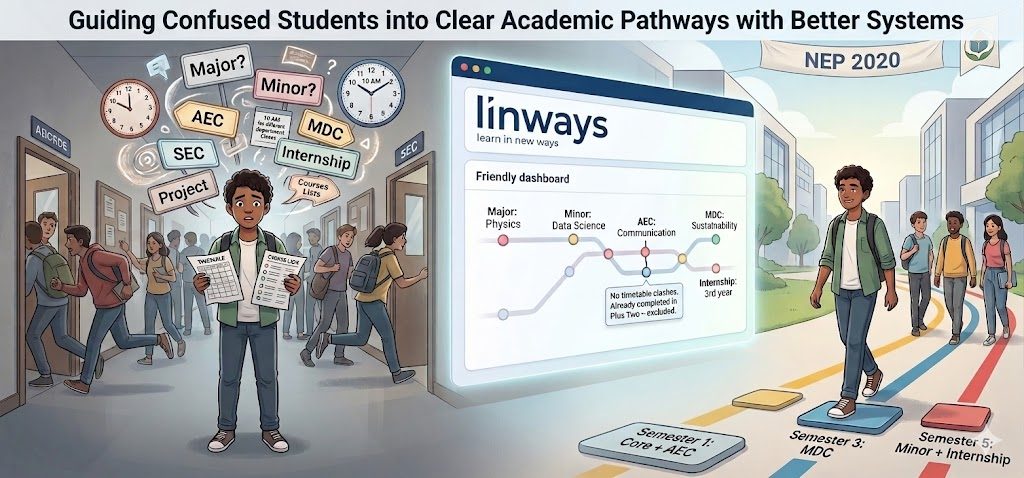
In this article, we look at how a structured academic pathway system covering curriculum configuration, course selection, allocation rules, and automation helps institutions implement NEP 2020/FYUGP effectively.
1. Curriculum Configuration: Structuring Flexible Learning
NEP 2020 encourages broad, multidisciplinary education. To operationalize this, institutions must configure their curriculum into well-defined components such as:
- Major
- Minor
- Ability Enhancement Courses (AEC)
- Multidisciplinary Courses (MDC)
- Skill Enhancement Courses (SEC)
- Value-Added Courses (VAC)
- Internships and Projects
- MOOC courses
These categories allow institutions to balance depth and breadth. Majors and minors provide disciplinary strength, while AEC, MDC, SEC, and VAC ensure that students build skills, values, and exposure beyond their core subject. Internships and projects connect learning to real-world practice.
A good Academic Management System should allow administrators to:
- Define and update these curriculum components as per regulations.
- Set credit structures and eligibility rules.
- Map courses to the right categories, departments, and programmes.
This structured configuration forms the foundation for flexible academic pathways.
2. Course Selection Options: Fair and Transparent Allocation
Once the curriculum is structured, students need a way to select from the available courses. Under NEP 2020, institutions often deal with large volumes of elective choices across batches and programmes. A well-designed pathway system supports multiple allocation strategies, such as:
- First-come, first-served (FCFS) for courses like AEC and SEC.
- Rank list–based allocation for MINOR and MDC courses where demand may exceed seats.
This ensures fairness and transparency. Students know how seats will be allotted, and administrators can align allocation policies with institutional priorities.
To support this, the system should:
- Capture student applications or preferences within a defined window.
- Apply allocation logic (FCFS or rank list) automatically.
- Ensure that results are auditable and consistent with policy.
3. Automatic Timetable Conflict Resolution
With students choosing from a wide range of courses, timetable conflicts can quickly become a major operational challenge. One student might get allocated to two courses that run at the same time, creating frustration and forcing manual interventions.
An effective academic pathway platform must automatically prevent such conflicts. When allocating courses, it should ensure:
- A student is never assigned to two courses offered in the same time slot.
- The system checks the timetable data before confirming allocation.
- Any change in timetable or course offering is reflected in future allocations.
This not only improves student experience but also saves significant time for academic and administrative staff.
4. Content Duplication and Course Repetition Controls
NEP 2020 encourages flexibility, but that does not mean students should repeatedly study the same content under different course codes. Institutions need mechanisms to ensure academic progression and avoid redundancy.
A robust system should:
- Detect when two courses have the same or substantially overlapping content.
- Restrict duplicate course allocation for a student.
- Prevent students from registering for courses they have already completed or which are equivalent to previously completed work.
By enforcing these rules, institutions maintain academic integrity and ensure that each course adds new value to the learner’s pathway.
5. Rank List Options: Merit-Based and Context-Aware Allocation
In many institutions, elective seats, especially for MINOR and MDC are limited. NEP 2020 allows institutions to design fair, merit-based ways to allocate these opportunities.
A flexible rank list engine can support different criteria at different stages:
- For first-year students, use higher secondary (Plus Two) marks or a composite index mark.
- After the first semester, switch to SGPA or marks obtained in the previous semester.
This approach has multiple advantages. It:
- Recognizes school performance for entry-level allocation.
- Rewards consistent performance in the university programme as students progress.
- Provides clear, rule-based criteria that students can understand and trust.
The system should support configuring these rank formulas and generating rank lists automatically whenever allocation is run.
6. Intelligent Exclusions: Enforcing Meaningful Choices
Not every course is suitable or necessary for every student. To keep pathways meaningful, certain courses need to be excluded automatically based on predefined rules. For example:
- Excluding courses that a student has already studied at the Plus Two level.
- Excluding courses offered by the student’s parent department when selecting MDC, so that MDC truly remains multidisciplinary.
By automatically filtering out ineligible or irrelevant courses, the system guides students toward academically richer and more diverse choices, in line with NEP 2020’s spirit.
7. Advanced Allocation Options: Handling Real Institutional Complexity
Beyond basic allocation, real-world institutions face many nuanced scenarios. A mature academic pathway solution should support options such as:
- Index mark generation and allocation, using custom formulas that combine different academic parameters.
- Continuous allocation, where as new students are admitted, the system can allocate or re-allocate courses based on the same criteria without manual recalculation.
- Separate allocation and seat counts for the same course under different categories, such as aided and self-financing programmes, or based on the teaching faculty or department.
- Allocation based on reservation policies, ensuring compliance with institutional and regulatory norms while maintaining fairness.
- Preference-based allocation, where students can rank their course preferences and the system allocates seats in a way that maximizes fit between student interest, major, and seat availability.
These capabilities allow institutions to mirror their real policies inside the system, instead of adjusting policies to match system limitations.
8. Why This Matters for NEP 2020 Implementation
NEP 2020 is ambitious in its emphasis on flexibility, multidisciplinary learning, and student choice. However, without the right systems, this flexibility can become chaotic and difficult to manage at scale.
A well-designed academic pathway platform:
- Translates policy into operational workflows.
- Protects students from timetable clashes, repeated content, and unfair allocation.
- Respects institutional constraints like seat limits, reservations, and programme structures.
- Provides transparency, auditability, and data for decision-making.
Most importantly, it allows students to experience the promise of NEP 2020: the ability to design meaningful, personalized academic journeys that align with their interests, strengths, and future goals.
When curriculum configuration, course selection, allocation logic, and automation come together in one coherent system, academic pathways stop being just a policy concept and become a practical reality in the day-to-day life of a campus.
9. The Role of a Technology Platform: Turning Policy into Practice
All of this complexity, configuring curricula, managing course options, enforcing constraints, and running fair allocations cannot be handled reliably with spreadsheets and manual workflows. This is where a modern academic management platform like Linways becomes essential.
A well-designed technology platform like Linways can:
- Centralize curriculum data, course structures, credit rules, and eligibility conditions, so that every decision is made on a single, reliable source of truth.
- Automate allocation processes using configurable rules for FCFS, rank lists, reservations, and preferences, drastically reducing manual effort and human error.
- Continuously validate constraints in real time, checking timetable clashes, duplicate content, prior learning, and department restrictions before confirming a student’s allocation.
- Provide transparent logs, reports, and audit trails so that institutions can demonstrate compliance with NEP 2020, internal policies, and regulatory expectations.
- Scale effortlessly as institutions introduce new programmes, interdisciplinary offerings, and larger student intakes, without needing to redesign processes from scratch.
Most importantly, a robust, research-backed technology platform like Linways AMS makes this flexibility truly manageable. It gives academic leaders a reliable way to experiment with new pathways, refine policies, and respond to changing student demand, while still ensuring that every student experiences a coherent, structured academic journey.
In this sense, Linways AMS is not just an enabler but a critical infrastructure layer for NEP 2020 and FYUGP. Without a capable platform underneath, academic pathways remain aspirational. With Linways AMS in place, institutions can confidently offer genuine choice, uphold academic quality, and help each learner build an academic pathway that leads to meaningful outcomes in life and work.
Book a personalized walkthrough with our higher education specialists.