
How the Brain Receives, Processes, and Stores Information
Blog Series: Part 1 The Anatomy of the Brain and the Nervous System
The human brain isn’t our largest organ, but it’s easily the most complex. In just a blink of an eye, it takes in sensory data, decodes it, and fires off instructions so our body can react instantly. If we can map out exactly how this lightning-fast process works, we can build plans that actually align with the biology of learning.
Billions of Cells Working Collectively
Ultimately, this entire process depends on cellular teamwork. Our body is made up of billions of specialized cells, each with a specific job that keeps us alive. Because these cells make up every organ, our internal control networks are no exception. Two primary powerhouses manage the body’s functions: the nervous system and the endocrine system. Working hand in hand, they constantly communicate to regulate and coordinate everything we do.
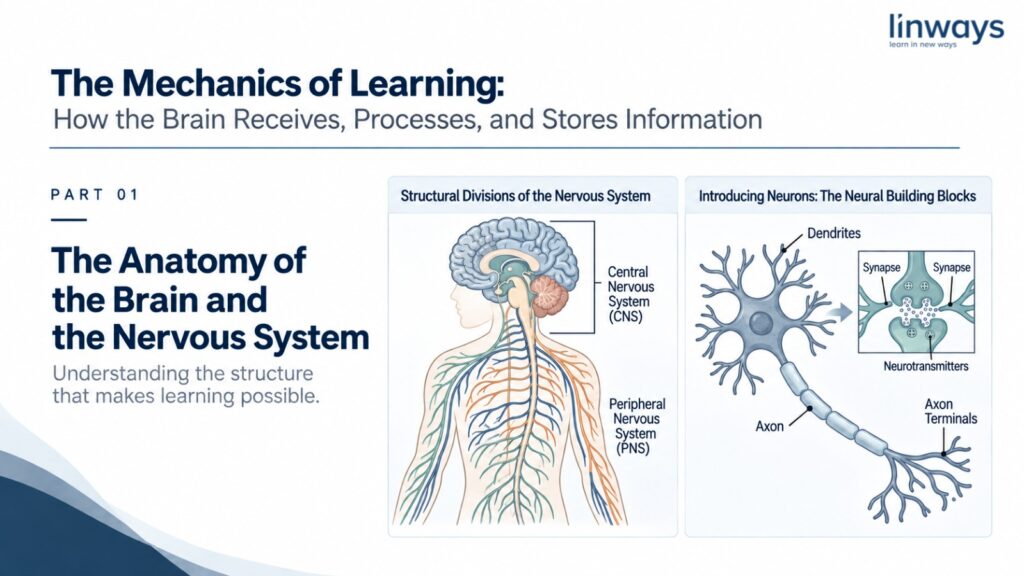
Structural Divisions of the Nervous System
As the body’s primary communication and control center, the nervous system splits into two main divisions: the Central Nervous System (CNS) and the Peripheral Nervous System (PNS). The CNS, which includes the brain and spinal cord, serves as the core command base. Connecting this hub to the rest of the body is the PNS, a vast network of pathways that act as a two-way street, relaying sensory data back to the brain while firing motor commands out to our limbs. Then, what exactly drives the speed of this lightning-fast network? At its core, the CNS depends on a team effort by two specialized cell types: neurons and glial cells.
Introducing Neurons: The Neural Building Blocks
Neurons are the essential building blocks and functional units of our entire nervous system. Unlike most other cells in the body, mature neurons generally do not divide to create new ones, meaning the ones we have must last a lifetime. Structurally, they are uniquely engineered with specialized pathways designed to transport signals across distinct communication junctions.
At the heart of each neuron is the cell body, or soma, which houses the nucleus and keeps the cell alive. Branching out from this center are dendrites, which act like tiny antennae catching incoming messages from neighboring cells. To send messages out, the neuron relies on a single long fiber called the axon, which extends from the soma and fires electrical signals down the line toward other neurons, muscles, or glands. Finally, at the very end of the line, numerous axon terminals form synapses with target cells, releasing chemical neurotransmitters to seamlessly pass the message along.
Think of the neuron as the system’s primary communication hub. It catches incoming signals through its dendrites, processes that data within the cell body, and shoots it down the axon toward its next destination. Yet, these neurons never actually touch. Instead, they are separated by a microscopic gap called a synapse. To bridge this divide, the sending neuron releases chemical messengers known as neurotransmitters. This rapid chemical conversion forms the fundamental language of our nervous system, driving everything from basic movement and physical sensation to complex focus, memory, emotion, and learning.
Glial Cells and Brain Plasticity
While neurons take center stage when it comes to firing signals, they cannot do it alone. Glial cells act as the ultimate backstage crew, nourishing and shielding those neurons while maintaining the perfect environment for neural communication to thrive.
Beyond this cellular teamwork, our brains are remarkably dynamic rather than rigid, fixed structures. From birth, the connections between our neurons are constantly adapting; new pathways are forged, old ones are refined, and unused ones are cleared away. A key part of this rewiring is synaptic pruning, a process where the brain declutters by stripping away weak, neglected pathways while strengthening the connections we use most. Ultimately, this means our everyday experiences literally shape our neural circuitry, remodeling the brain’s architecture over time.
In the next blog, we will shift our focus to the physical anatomy of the brain, breaking down its primary structures and functions to reveal how they collectively support the acquisition of knowledge.