
Why do some people seem “naturally gifted” while others struggle with even basic skills?
From a scientific perspective, exceptional performance is almost never just a matter of lucky genes. It is usually the result of focused practice, repeated over time, especially during key stages of brain development. Even in adulthood, our brains remain capable of change and growth through the process called neuroplasticity which we have discussed in our previous blogs.
When we learn something new, our brain forms tiny connections between neurons, called synapses. With continued practice, these connections strengthen and thicken, turning effortful learning into something that feels automatic and easy. The earlier we start, the easier this process can be, but it never fully closes off. Adults can still learn quickly and deeply if they work with how the brain actually functions.
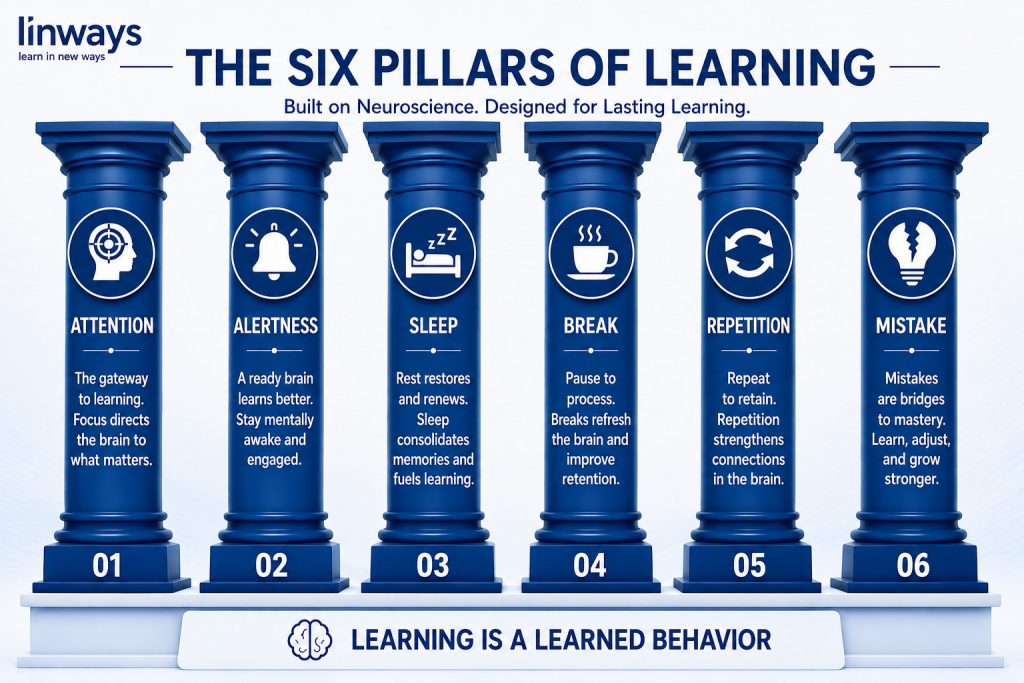
Neuroscientist Dr. Lila Landowski describes six core pillars that support fast and effective learning. By understanding and applying these pillars, we can engineer our own ‘genius.’
1. Attention: Single-Tasking to Learn Faster
Our brains are designed to focus deeply on one thing at a time. When we split our attention by checking messages, browsing, or multitasking during study or work, we overload our working memory. This makes it harder for information to move from short-term memory into long-term memory.
Sustained attention is like a spotlight. Wherever it shines, the brain is more likely to build strong neural connections.
The Technique: Before you start learning, spend a few minutes preparing your brain to focus. Two simple, science-backed methods are:
- 20 minutes of moderate exercise (like brisk walking or cycling), which boosts blood flow and helps you concentrate.
- A short focused-attention meditation, where you gently bring your attention back to your breath or a single point whenever it wanders.
These small rituals calm distractions and prime your brain for deep learning.
2. Alertness: Using Your Natural Rhythms
We have to be alert to be attentive. When we are alert, our autonomic nervous system releases chemicals like epinephrine (adrenaline) and norepinephrine. These sharpen our awareness, reaction time, and decision-making.
However, our brains do not stay at peak alertness all day. We tend to operate in 90-minute cycles, known as ultradian rhythms. After each 90-minute period of intense focus, we naturally dip into a 5–20 minute phase of lower alertness. During these dips, forcing yourself can reduce learning quality.
The Technique: Respect your alertness cycles.
When you feel your focus drop, instead of pushing through mindlessly:
- Take a short break.
- Do a brief breathing exercise.
- Stand up, stretch, or walk around.
These simple actions help reset your nervous system so that when you return, your brain is ready to process and retain information again.
3. Sleep: The Brain’s Memory Engine
Sleep is not just rest; it is active brain work. During sleep, your body:
- Resets parts of the immune system
- Regulates metabolic functions
- Stabilizes emotional control
- Most importantly for learning, consolidates memories
Throughout the day, the hippocampus acts like a temporary storage drive, holding new experiences and information. During deep (slow-wave) sleep and REM sleep, the brain replays these experiences and transfers them from the hippocampus into the neocortex for long-term storage. This is when newly formed synaptic connections are strengthened and made more permanent.
If sleep is poor or insufficient, this transfer process is disrupted. You may learn something during the day but find that it doesn’t stick.
The Technique: Protect your sleep hygiene to protect your learning.
That means:
- Keeping a consistent sleep schedule.
- Reducing heavy meals, caffeine, or bright screens close to bedtime.
- Giving yourself enough total hours of sleep.
If you are serious about learning faster, think of sleep as part of your study plan, not a luxury.
4. Repetition: Strengthening the Neural Pathways
We often hear “practice makes perfect,” and while perfection is debatable, practice does make pathways. Just as muscles grow through repeated exercise, neural connections grow stronger through repeated activation.
Over time, the neural pathways involved become faster and more efficient, making the skill feel natural and automatic.
However, how you repeat matters as much as how often.
One powerful method is spaced repetition: instead of cramming, you revisit the material at increasing intervals over several days or weeks. Each time you recall the information after a gap, the brain must work a bit harder to reconstruct it, which actually reinforces the pathway more strongly.
The Technique: Use spaced repetition to deepen learning.
For example:
- Review new material on the same day.
- Revisit it the next day.
- Then again after a few days.
- Then after a week, and so on.
This pattern of “forget slightly, then recall” is far more effective than repeated, massed practice in a single long session.
5. Breaks: Protecting New Learning from Retrograde Interference
Children’s brains are extremely malleable; their neural networks adapt quickly and easily. Adults can still change their brains, but new connections tend to be more unstable at first.
Right after we learn something new, that fresh memory is vulnerable to retrograde interference. This happens when new information comes in quickly and overwrites or weakens what we just learned. In practical terms, if you immediately jump from one demanding task to another with no pause, you may accidentally blur or erase the gains from the first task.
The Technique: Take deliberate breaks to let learning settle.
Short, intentional pauses between learning sessions give your brain time to:
- Replay recent information subconsciously
- Stabilize new neural patterns
- Protect fresh memories from being overwritten
Even a few minutes of quiet reflection, light movement, or stepping away from screens can help lock in what you just learned.
6. Mistakes: Turning Errors into Fuel for Growth
Many of us are conditioned to see mistakes as failures or signs that we “aren’t good enough.” Biology tells a different story.
When you make an error, your nervous system detects a mismatch between what you expected and what actually happened. This triggers a mild stress response and releases chemicals such as epinephrine and acetylcholine. You may feel this as a spike of anxiety, frustration, or discomfort but it is also the brain shifting into a state of heightened plasticity, ready to change and improve.
If you quit at this point because the feeling is unpleasant, you miss the opportunity to reshape your neural circuits. But if you stay with the discomfort, correct the mistake, and try again, the brain rewards you. Dopamine is released when you successfully fix an error or achieve a difficult goal, strengthening the new, more accurate pattern and increasing your motivation to keep going.
The Technique: Redefine your relationship with mistakes.
- Notice the emotional spike when you get something wrong.
- Instead of withdrawing, use it as a signal, ‘My brain is ready to rewire.’
- Focus on understanding why the error happened, correct it, and repeat the right version.
Over time, this cycle of error, adjustment and reward builds resilience and accelerates learning.
Engineering ‘Genius’ – Putting It All Together
Geniuses are rarely just born; they are shaped by habits, environments, and strategies that align with how the brain naturally learns.
The struggle you feel when you are learning something new is not proof that you are limited. It is the subjective experience of your brain reorganizing itself at a structural level. Neurons are forming new connections, strengthening useful pathways, and pruning weak ones.
To learn faster and more permanently, we must design our approach around these six pillars:
- Direct our attention to one task at a time
- Work with our natural cycles of alertness
- Protect and prioritize sleep
- Use intelligent repetition, especially spaced over time
- Insert breaks to stabilize new learning
- Embrace mistakes as triggers for growth, not as signs of failure
When we align our habits with the brain’s biology, rapid learning stops being a mystery reserved for the “naturally gifted” and becomes a practical skill anyone can cultivate with intention and practice.
At Linways, we believe that when we build technology, it must always align with the core principles.
Book a personalized walkthrough with our higher education specialists.